The outcry over Döllner’s appearance with Trump is loud. But the real debate is only just beginning: Why is a multi-billion dollar plant profitable for Audi in Georgia – and not in Germany? A commentary.
The outrage over Gernot Döllner’s appearance on Donald Trump’s show is free . What’s expensive is what lies behind it: the fact that Audi’s plan with the plant in Georgia is working out is the real problem for Germany as a business location.
Döllner thanked a president whose tariff policies hit Audi hard in 2025. He did so on a campaign stage in Perry, Georgia, ten days before the US midterm elections, after Donald Trump himself had announced Audi’s multi-billion dollar investment there. Does that make any sense?
According to the company’s code of conduct, public meetings with candidates are prohibited in the three months leading up to an election. According to VW Group Works Council Chairwoman Daniela Cavallo, Döllner only signed these guidelines a few months ago.
Cavallo calls it a „propaganda show“
Cavallo calls the appearance highly problematic and refers to it as a „propaganda show.“ However, it is reported that the Audi board had approved an exception to the internal guidelines. The political conflict thus remains; whether Döllner unilaterally violated the rules is another question.
What’s striking is what the critics don’t say. Cavallo concedes that a US production can make perfect business sense. Apparently, hardly anyone has anything against the film itself.
But outrage is convenient. It can be summed up in a single sentence and ends with a resignation or an apology. The uncomfortable debate begins with the question of why a prime ministerThe manufacturer will build in Georgia in 2026, not in Ingolstadt .
The bill
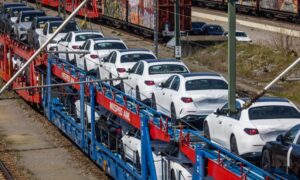
Audi currently produces its large SUVs, the Q7 and Q8, in Bratislava and ships them across the Atlantic. Since 2025, cars originating in the EU are generally subject to a total customs duty of 15 percent in the USA, unless a higher standard duty rate applies.
In 2025, US tariffs negatively impacted Audi’s operating profit by €1.2 billion ; US sales fell by 16 percent that same year. According to Döllner himself, the business is currently not profitable there. Yet one in ten Audi vehicles is sold in the US, and several competitors have been producing there for years.
According to Audi, the plant near Macon, Georgia, is slated to produce up to 200,000 vehicles annually starting in the early 2030s, employing around 4,500 people. The tariff barrier is designed to attract production to the country, and Audi is following the example of other manufacturers before it. It’s important to note that despite the announcement, the plant is still subject to [unclear – possibly “ …Subject to final approval by the Volkswagen Supervisory Board .
What Georgia is not
Is Georgia a cause of job cuts in Germany? The cars from Macon are initially intended to replace models that have previously been exported from Slovakia to the USA. The situation poses an indirect threat to the German plants: if Bratislava exports less, models from Germany could be relocated there. Neckarsulm, already operating at low capacity, would then be a likely candidate.
The problem existed before as well. In March 2025, Audi agreed to cut up to 7,500 jobs by 2029, in return for which they provided a job guarantee until 2033. Making Georgia the scapegoat doesn’t protect Neckarsulm.
The figures at Volkswagen
The precariousness of the financial situation is illustrated by the parent company, Volkswagen. The group reported an operating loss of €5.86 billion for the third quarter of 2026. The lion’s share of this loss is due to special items totaling €7.8 billion, primarily non-cash write-downs on the Porsche subsidiary.In purely mathematical terms, after adjusting for these special effects in day-to-day business, a quarterly profit of almost two billion euros remains.
Day-to-day business isn’t yielding much. Excluding special items, the operating margin after nine months is 3.8 percent. For the full year, VW expects an operating return on sales of between zero and one percent . CFO Arno Antlitz admits that VW is currently earning less with electric cars than with combustion engine vehicles . And in this situation, a board member announces a billion-euro investment abroad.
What follows from this?
Döllner’s calculations may work out from Audi’s perspective. Whether they will work out for the company in the long term – and what they will cost Germany – remains to be seen. That’s the bad news for the German production site.
Ingolstadt has to compete with Georgia on energy costs, wages, and working conditions. Little can be done in Berlin about tariffs, but action can be taken on energy prices, permitting times, and taxes. Who wants the next AWhen the Audi boss announces a factory in Ingolstadt, Ingolstadt must be made competitive against Macon.
That doesn’t absolve the corporations of their responsibility. A manufacturer whose US business isn’t profitable needs models that buyers want and a sustainable cost structure. No location advantage can replace that.
Factories go where they are profitable. This can be lamented or changed. There has been enough lamenting since Saturday.
Source : focus.de