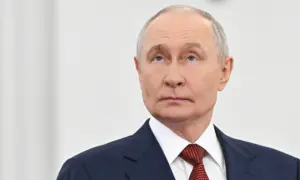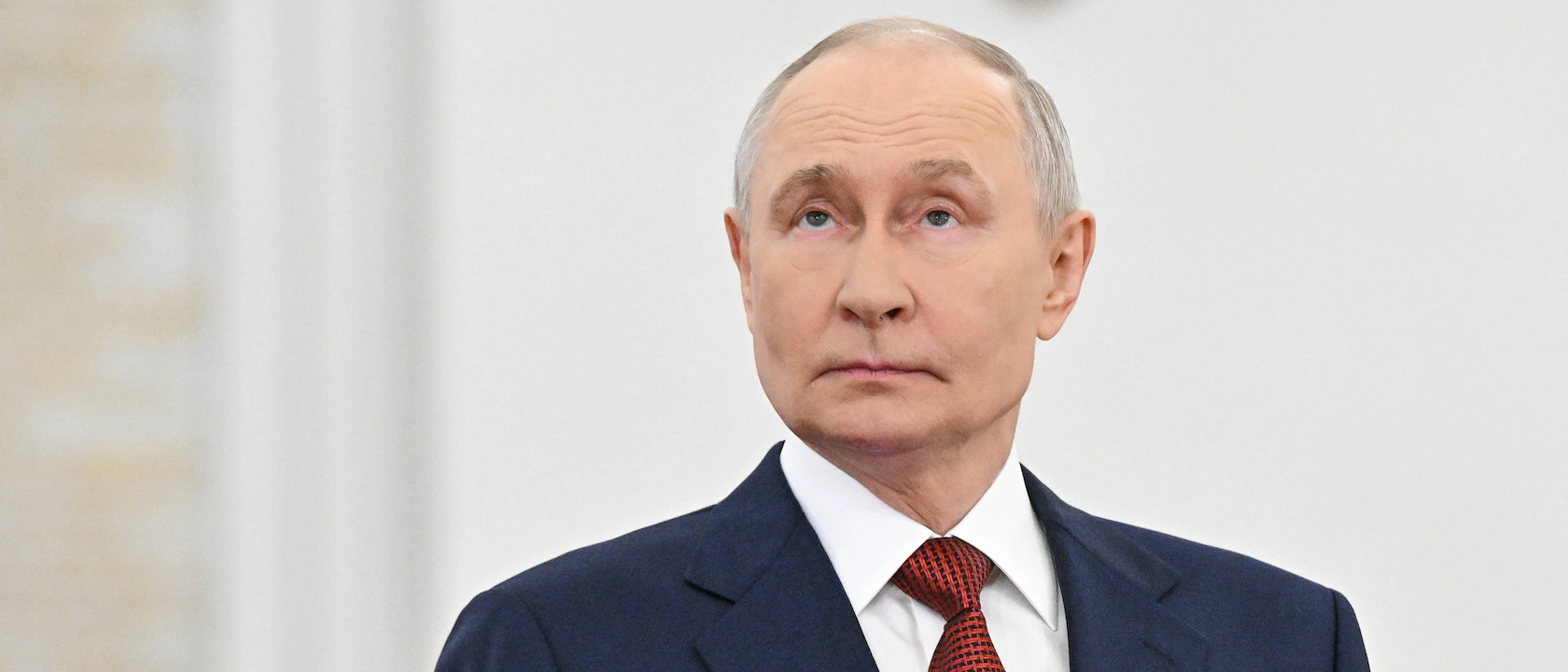
The CIA director’s surprise visit to Moscow has put the Kremlin and Vladimir Putin on the defensive. While Russia is downplaying the visit, its propaganda machine is constructing a threat narrative.
The head of the American foreign intelligence agency CIA makes a surprise trip to Russia , stays in Moscow for only a few hours , and then leaves again. And what does the Kremlin do? It does everything in its power to downplay the sudden visit as a mere footnote.
Kremlin spokesman Dmitry Peskov simply denies that a meeting between John Ratcliffe and Vladimir Putin took place, even though the Russian president had another appointment on his calendar that day and Ratcliffe was driven through the center of the Russian capital.
The head of Russia’s foreign intelligence service, the SVR, appeared before the cameras and described the visit as a „routine working meeting.“ He met with the heads of various intelligence agencies from around the world practically every week, Sergei Naryshkin chattered away, seemingly affable. Shortly afterward, however, it emerged that the CIA chief had likely not met with Naryshkin at all, but rather with FSB chief Alexander Bortnikov, a longtime confidant of Putin .
An ultimatum to Vladimir Putin? An impossibility.
Meanwhile, Russian television has been either completely silent all week, or propagandists have been fighting to dispel the impression that the Americans might have brought a warning for Putin. An ultimatum to Vladimir Putin? For Kremlin propaganda, that’s out of the question. The prevailing narrative is that it’s hardly conceivable the CIA director would appear before the Russian president and deliver a formal warning.
Instead, viewers are presented with other reasons for the visit: an exchange of information, for example, or Washington’s demand to reduce the intensity of Russian attacks on Ukraine . The CIA chief as a supplicant – that fits better into the Kremlin’s worldview.
Kaliningrad becomes the scene of a Western attack
While Moscow downplays the CIA chief’s visit, Russian propaganda paints a threatening picture of the situation in Europe. The focus is often on Kaliningrad: NATO is allegedly preparing an attack on the Russian exclave . Finland is supposedly planning a preemptive strike, and the Western alliance allegedly wants to neutralize Kaliningrad’s military capabilities.
An attack on the region has already been repeatedly discussed within
NATO as a possible scenario, according to the unsubstantiated claim. NATO simply lacks the funds for a major war against
Russia – for now. However, the „rotting collective West“ is already searching for the necessary resources, proclaim alleged experts in Russian political talk show studios.
In the event of an attack, Russia is preparing for a radical response, announced Andrei Kolesnik, a member of the Russian State Duma’s Defense Committee, last Friday. The Russian side is examining possible scenarios in the event of a NATO attack on Kaliningrad. He asserted that Moscow does not intend any aggression. However, he added that Russia has the means to „cool down any hothead.“ According to him, sometimes one has to „light the torch of war“ so that the adversaries understand the potential consequences.
Vladimir Putin turns attack into defense
And voilà! Suddenly, Russia appears not as a potential source of a new escalation, but as a victim that must defend itself against an allegedly imminent NATO attack. This reversal is precisely what Russian propaganda is all about.
This creates a threat scenario that, in a serious situation, can also be used as justification for further steps: Should the military situation escalate, the Russian intervention can be portrayed as a reaction: not as an attack, but as the supposed protection of Kaliningrad.
The tactic is by no means new: Kremlin propaganda has always portrayed the attack on Ukraine as an act of self-defense – as a form of self-defense.
NATO fears horizontal escalation by Russia
On NATO’s eastern flank, there have been fears for months of an escalation of the war by Russia . This uncertainty is particularly palpable in the Baltic states. In this context, a new term has entered the vocabulary of European diplomats and intelligence services: horizontal escalation. This refers not to an intensification of the war within Ukraine, but rather to a geographical expansion of the conflict beyond Ukraine .
This scenario has been the subject of intense discussion since the spring. Concerns are growing that Russia could extend the war to other parts of Europe.
Russian and Belarusian nuclear exercises , as well as renewed tensions surrounding Kaliningrad, are intensifying these suspicions. Most recently, Moscow conducted mobilization exercises in the enclave – a clear signal to the West.
Source : t-online.de